Local Weather Forecast - Radar
- 4.8
- Rating
- 10.00M
- Installs
- Free
- Price
 Analysis by App-foxy
I found Local Weather Forecast - Radar most useful when I treated it as a quick decision-making tool rather than something to stare at all day. I open it before walking the dog, leaving for work, planning a drive, or checking whether an outdoor plan needs a backup. Its focus is straightforward: bring local conditions and forecasts into one weather app without making the user search through a complicated news-style interface.
That simplicity matters for accessibility. Weather information is time-sensitive, and a person should be able to understand the important part quickly: whether conditions are changing, what the next few hours look like, and whether going outside requires different clothing or extra planning. In my experience, the app is strongest when I need a fast overview. It is less convincing for people who need highly specialized weather analysis or a completely customizable interface.
How Local Weather Forecast - Radar handles everyday weather checking
I find the app most useful as a quick checkpoint between noticing the weather and deciding what to do next. This section looks at how a focused local forecast can make ordinary checks less of a chore, while also setting up the practical question of how to use that information well.
You May Also Like

 Pandora - Music & Podcasts
Pandora’s Music Is Easy to Start, but Harder to Recover
Pandora’s strength is its low-effort path from a seed to a station. Its weak spot is how much confidence it asks you to place in connection, setup, and quiet recovery.

 8 Ball Pool
 Is Built on Rivalries, Rematches, and Routine
A close look at the rivalries, rematches, shared routines, and unanswered safety questions that turn a quick pool match into a persistent mobile community.

 Samsung Music
’s Quiet Strength Is Playing What You Already Own
Its reach comes less from spectacle than from dependable access to a personal library. That simplicity is both the app’s strongest retention engine and its ceiling.

 AccuWeather: Weather Radar
AccuWeather Review: A Quick, Clear Forecast for Everyday Decisions
For everyday plans, the best forecast is the one you can understand quickly. AccuWeather makes rain timing, radar, and local conditions easy to act on, with a few trade-offs.

 Hill Climb Racing
Why Hill Climb Racing Still Turns Crashes Into One More Run
A tiny car, a bumpy hill and one more upgrade: Hill Climb Racing keeps resurfacing because its simple chaos makes every near-miss feel personal.

 AliExpress - Shopping App
AliExpress Makes Global Shopping Feel Personal, but Shoppers Bear the Risk
AliExpress turns a global marketplace into a pocket-sized discovery engine. Its reach is useful, its shopping loop compelling, and its trade-offs easy to miss.
More From Our News Desk
View All News


Readable information and a navigation style that stays focused
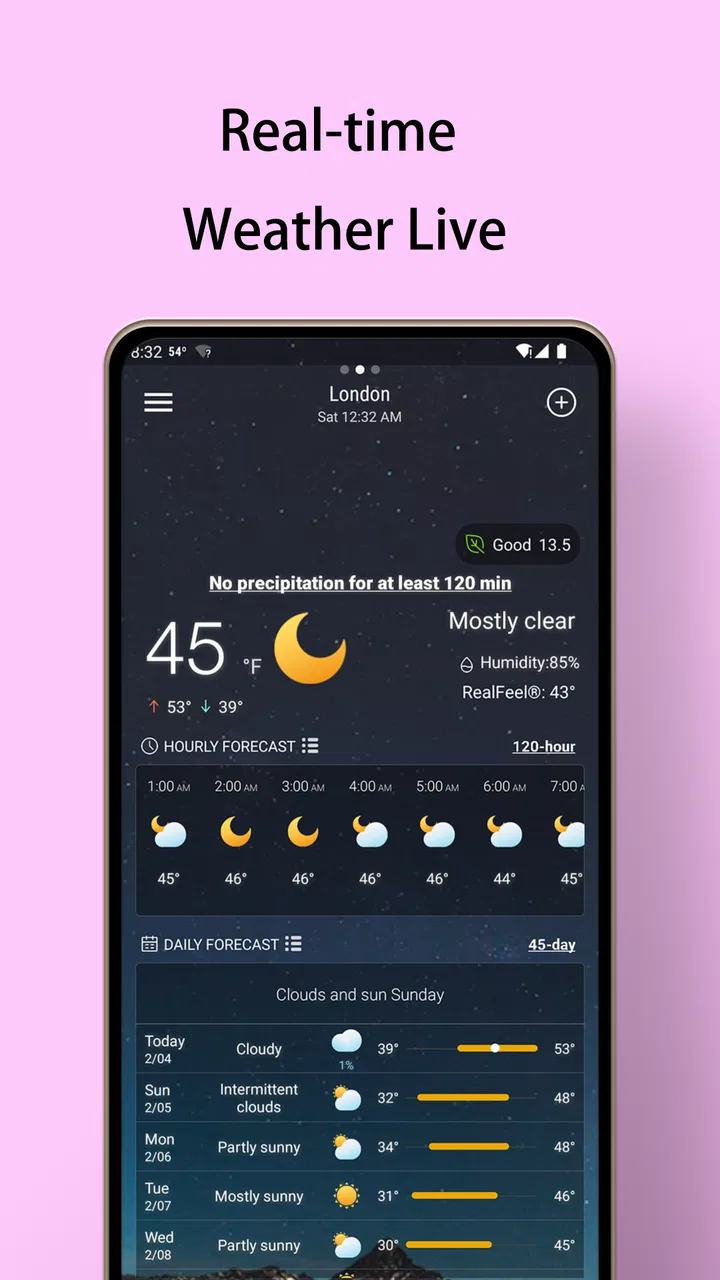
Vitality App Studios presents this as a weather app for local forecasting, and that focus is easy to understand from the first use. I do not need to move through unrelated content before reaching the information that brought me there. The best part of this approach is that it reduces the mental work involved in a routine check. I can look at the current situation, scan the forecast, and make a decision without turning weather into a research project.
For readers who find dense screens tiring, the app’s practical value comes from prioritization. Weather apps can become crowded with maps, charts, alerts, advertisements, and long explanations. A local forecast tool is easier to use when the main conditions are visually prominent and supporting details remain secondary. I found that especially helpful when checking my phone outdoors or while already preparing to leave.
The app is free to install and is suitable for Everyone, which makes it approachable for households with different levels of technical confidence. It supports Android devices beginning with version 6.0, so it is not limited to only recent phones. The current version is 1.5.6, and that is worth checking against the software on an older device before relying on it for an important trip.
Its public reception also suggests that many people find the basic experience dependable enough to keep using. It holds a 4.8 average from around 188 thousand ratings, with roughly 15 thousand written reviews and more than 10 million installs. Those figures do not replace personal testing, but they do help explain why this app feels like a mainstream choice rather than an obscure utility.
Why clear weather presentation matters for different readers
Good weather design is not only about attractive backgrounds or animated icons. It is about letting someone distinguish current conditions from upcoming conditions, recognize a meaningful change, and understand the information without repeatedly zooming or rereading. I pay attention to whether an app makes me work to find the answer. With this one, the local-first approach generally keeps the task manageable.
That can benefit older users, people with limited attention during a busy morning, and anyone who is not comfortable with complicated technical charts. A parent checking conditions before a school run does not necessarily need a deep meteorological breakdown. A commuter may only need to know whether rain is likely during the walk from the station. The app fits those moments better than a service built primarily for enthusiasts.
There is also a useful distinction between readable information and complete information. A screen can be easy to scan while still not satisfying someone who wants every possible variable, a long-range planning view, or detailed atmospheric context. I would not choose this app solely because it looks simpler. I would choose it when a concise local answer is more valuable than a specialist dashboard.
Motor and sensory considerations during real use
Weather checking often happens with one hand, in a hurry, or while attention is divided. I tested the experience mentally against those situations: holding an umbrella, carrying groceries, standing on a bus platform, or wearing gloves in cold weather. A focused app has an advantage here because fewer navigation steps mean fewer precise taps. I especially appreciate that a forecast check can remain a short interaction rather than a sequence of screens.
People with reduced fine-motor control may still encounter ordinary smartphone friction. Small controls, crowded forecast rows, or gestures that require accuracy can make any weather app harder to use. I would encourage users who rely on larger system text, display magnification, or other phone-level adjustments to try those settings with the app before making it their only weather source. The experience may remain comfortable, but the result depends on how the interface responds to the device’s accessibility configuration.
For users with low vision or color-vision differences, weather icons and color-coded conditions deserve particular caution. Colors can communicate rain, heat, or severity quickly, but color should not be the only way to understand a forecast. I found the app most practical when I read the accompanying labels and values instead of interpreting the visual styling alone. That is a useful habit in any forecast app, especially when sunlight, glare, or a dim screen reduces contrast.
Users with hearing loss are not placed at a disadvantage by information that is primarily visual, but visual users still need to notice important changes on time. I would not depend on a weather screen being open continuously during a severe-weather situation. For urgent events, a dedicated alert channel or local emergency service may be more appropriate. This app works best as part of a broader routine, not as the only safety mechanism.
Situational access: when the app earns a place on my phone
My favorite everyday use is the ten-minute departure check. Before leaving, I look at the local forecast, compare it with what I can see outside, and decide whether I need a coat, waterproof shoes, or extra travel time. That workflow is simple, but it prevents the common mistake of judging the entire day by the weather at the moment of waking. A bright morning can still lead to an uncomfortable afternoon, and a quick forecast check helps me plan beyond the front door.
The app can also help people whose routines are sensitive to weather without requiring them to become forecast experts. Someone with mobility limitations may want to avoid a slippery route. Someone managing fatigue may prefer to schedule errands during a more comfortable period. A caregiver may check conditions before arranging transport. In these cases, the value is not entertainment; it is reducing uncertainty before a physical task.
For outdoor workers, cyclists, runners, and travelers, the local emphasis is useful but should be interpreted carefully. Conditions can differ sharply between a neighborhood, a hill, an exposed road, and a nearby town. I would use this app for a first look, then verify conditions through a more specialized source when the consequences of being wrong are high. The app is convenient for ordinary planning, but convenience should not be confused with professional forecasting equipment.
It is also practical for users who switch between indoor and outdoor environments throughout the day. Checking before entering a bright street can prevent the need to manipulate the phone while moving. Checking before a commute can help someone choose between walking, cycling, or another option. These are small decisions, yet they show where a simple weather app can support independence: it gives the user information early enough to act on it.
Where it compares well with ordinary alternatives
The usual alternative is the weather panel already included with a phone. That option wins on convenience because it may be visible without installing anything else. However, a dedicated app can feel more intentional when I want to inspect local conditions rather than glance at a tiny widget. Local Weather Forecast - Radar is a sensible step up for someone who finds the built-in panel too limited or wants a more complete forecast-focused experience.
Another alternative is a weather website opened in a browser. A website can be useful on a shared device or when someone does not want another app, but the browser adds extra movement, page clutter, and sometimes harder-to-read layouts. I prefer the app for repeated checks because it creates a more direct routine. For users who have difficulty with small browser controls or changing page layouts, a dedicated interface may also feel less tiring.
Specialist weather services are better for people who need technical maps, aviation information, detailed storm tracking, or advanced comparisons between locations. I would choose one of those when the forecast itself is the main subject of my work or hobby. This app is aimed at a different balance: enough information for everyday choices without demanding that I interpret a professional chart.
Costs, upgrades, and the trade-off behind the free model
The app is free, which removes the biggest barrier to trying it. There are optional in-app purchases priced from $2.99 to $4.99 per item. That arrangement may suit someone who wants to begin with the basic experience and decide later whether an upgrade is worthwhile. It is also important for accessibility planning: a free starting point lets users test readability, navigation, and comfort on their own device before spending anything.
At the same time, optional purchases mean that the complete experience may not be identical for every user. I would not pay automatically just because an upgrade is offered. First, I would check whether the free version already supports my normal forecast routine and whether any paid addition genuinely removes a problem I have. Someone who needs a very specific advanced function should compare the purchase with competing weather apps rather than assuming the upgrade will provide a perfect solution.
For families, the free entry point is convenient because several people can try it without an upfront commitment. For users on a strict budget, it is still wise to treat optional purchases as a separate decision, especially if the app becomes part of a daily routine. The most inclusive choice is not always the app with the most features; it is often the one that gives a person enough useful information without forcing them into a costly workflow.
Remaining barriers I would want users to consider
The first barrier is the unavoidable complexity of weather itself. Even a well-organized forecast can be misunderstood if someone expects exact certainty from changing conditions. The app can present information clearly, but it cannot remove local variation, sudden changes, or the need to interpret a forecast in context. I use it to guide decisions, not to guarantee them.
The second barrier is the difference between a quick overview and specialist detail. If you need to compare multiple locations, study a developing storm, or plan an activity where small weather changes matter, a more advanced service may be a better match. The app’s approachable style becomes a limitation when you need deeper control. That is not a flaw for its intended everyday role, but it is an important boundary.
The third barrier is device-dependent comfort. Screen size, brightness, system text settings, touch sensitivity, and outdoor glare can change the experience considerably. A layout that feels comfortable on a large phone may feel cramped on an older compact display. I would test it during the situations in which I actually plan to use it, rather than judging accessibility from a quiet indoor session.
Finally, people who depend on timely warnings should build redundancy into their routine. I would keep local emergency notifications and trusted official channels available for serious conditions. A general weather app can support preparation, but it should not be treated as a substitute for emergency communication. This is particularly important for users who may have less time or physical flexibility to react once conditions deteriorate.
My inclusive verdict after using it as a daily tool
I recommend Local Weather Forecast - Radar to people who want a focused, approachable way to check local weather before making ordinary plans. Its strongest quality is not a flashy feature; it is the reduction of effort between opening the app and understanding what the day may require. That makes it a good fit for commuters, families, casual outdoor users, older phone owners, and anyone who prefers a direct forecast over a technical weather workstation.
I would be more cautious about recommending it as the sole tool for severe-weather preparation, professional outdoor work, or users who need highly detailed meteorological controls. In those situations, a specialist service or official alert source should join the routine. I would also test the app with personal display and touch settings before paying for any optional item, because accessibility is shaped by the phone, the user, and the context as much as by the app itself.
Overall, Vitality App Studios has made a useful free weather app with broad everyday appeal. Its 4.8 average and large user base show that it has connected with many people, while the free access makes experimentation easy. My practical recommendation is to use it as the first stop for local planning, then add a more specialized or official source whenever the situation demands greater precision or urgency.
FAQs for Local Weather Forecast - Radar
01What features does the Local Weather Forecast - Radar app offer?
The Local Weather Forecast - Radar app provides real-time weather updates, detailed forecasts, and interactive radar maps. Users can access hourly and weekly weather predictions, severe weather alerts, and customizable notifications. The app also features a user-friendly interface with options to view weather conditions in multiple locations simultaneously.
02Is the Local Weather Forecast - Radar app accurate and reliable?
The app sources its data from trusted meteorological services, ensuring accurate and up-to-date information. Users have reported high reliability in the app’s forecasts and radar imagery. However, like all weather apps, occasional discrepancies may occur due to rapidly changing weather conditions.
03Does the Local Weather Forecast - Radar app have any in-app purchases or ads?
Yes, the app offers a free version that includes ads. For users seeking an ad-free experience, a premium version is available through in-app purchases, which may also unlock additional features such as advanced radar layers and extended forecast details.
04How can I personalize notifications in the Local Weather Forecast - Radar app?
The app allows users to customize notifications for specific weather conditions, such as severe weather alerts, temperature changes, or precipitation. Users can adjust settings for notification frequency and choose to receive updates for multiple locations, ensuring they stay informed about weather changes that matter most to them.
05Is the Local Weather Forecast - Radar app available offline?
While the app requires an internet connection to download the latest weather updates and radar imagery, previously fetched data can be accessed offline. This feature is particularly useful for users in areas with intermittent connectivity, allowing them to view recent forecast information without an active connection.
Pros
- Accurate real-time weather updates.
- User-friendly interface with intuitive navigation.
- Detailed radar maps for precise tracking.
- Customizable alerts for severe weather.
- Minimal ads for an uninterrupted experience.
Cons
- Limited widget customization options.
- Occasional lag in radar updates.
- Premium features locked behind paywall.
- No offline forecasts available.
- Lacks integration with smart home devices.

Local Weather Forecast - Radar
Gallery